
Loading content...

Articles
Longevity Risk and the Institutional Portfolio: A Quiet Revolution
Longevity Risk and the Institutional Portfolio: A Quiet Revolution
A structural shift is underway in institutional investing. Longevity risk - the chance that people live longer than expected is no longer just an actuarial concern. For U.S. pension funds, insurers, and long-horizon asset managers, it is emerging as a central portfolio risk. This article explores how this demographic shift is reshaping portfolio strategy, capital markets, and risk frameworks in the United States, using the latest data.
Traditionally, investment risk models focused on interest rate, inflation, and market volatility. Now, rising life expectancy is extending liabilities and pressuring funding ratios.
The number of Americans reaching age 100 is expected to quadruple over the next 30 years. For couples retiring at 65, there’s a 20% chance that one partner will live to at least 100.
While the average retirement lasts 18 years, many retirees will require income for 25–30 years, increasing the risk of outliving assets. As defined benefit plans mature and shift toward de-risking, this long-tail risk becomes more material, yet many U.S. institutions still underrepresent it in their asset-liability frameworks.
U.S. pension funds are increasingly transferring pension risk to insurance companies, offloading the responsibility of paying out pensions considering the longevity risk.
The impact is clear: U.S. life insurance industry premium volume surged 19.4% to $264.62 billion in Q1 2024, boosted by large pension risk transfer deals. However, unlike the UK, the U.S. market for longevity swaps and capital market-based hedges is less developed; most risk transfer still uses traditional group annuity buyouts.
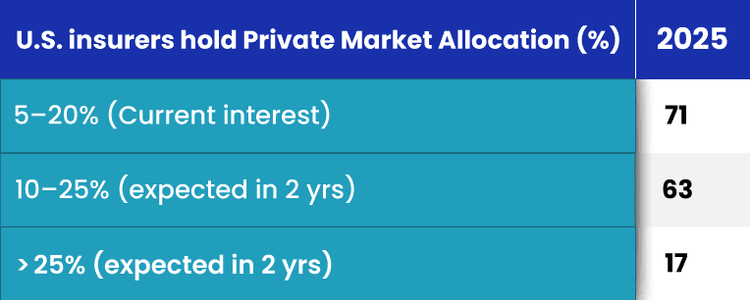
U.S. insurers are extending portfolio duration to better match longer liabilities. In 2025, 64% of insurers plan to increase portfolio duration, reflecting a shift toward longer-dated fixed income to hedge extended payout horizons.
According to Conning’s survey Private asset allocations are rising in 2025.
To stay ahead of the curve, U.S. CXOs should:
Conclusion: From Footnote to Frontline Risk
Longevity risk has become a defining force in U.S. institutional portfolio construction. Those who respond early, by integrating new hedging mechanisms and adapting portfolio structure, will be better positioned to meet long-term promises and seize opportunities as demographics drive capital flows
All rights reserved ©2026 Decimal Point Analytics Pvt. Ltd.