Loading content...

Articles
Severe Convective Storms: The Evolution of a Core CAT Risk
Severe Convective Storms: The Evolution of a Core CAT Risk
All rights reserved ©2026 Decimal Point Analytics Pvt. Ltd.
How SCS risk is reshaping pricing, underwriting, capital models, and reinsurance strategy
SCS is an uncommon acronym for a fast-becoming common insurance boardroom discussion item viz. “Severe Convective Storms” risks.
These are short-duration, highly localized but intense weather events caused by atmospheric instability (warm, moist air rising rapidly), these are highly localized, intense weather events of relatively short duration which result in burst of damage to life and property. Frequently these take the shape of Hailstorms, Tornados, Heavy rainfalls, flash floods and Straight-line winds (‘derechos’). What makes them tricky and dangerous is their sudden development, geographical spread and THESE DAYS frequent occurrences.
The insurance industry is reeling under the mounting losses due to these events on account of their sudden occurrences, higher frequencies, expanding urban exposures and rising asset values (roofs, solar panels, high end cars and sophisticated but expensive automotives).
Let us walk back in history to see how the relevance of SCS (Severe Convective Storms) has been evolving. Till before 2010 Insurance sector normally classified SCS, Flood and Wildfire as ‘Secondary Perils” while Primary Perils were Hurricane/ Earthquake etc. Thus, SCS was a background or Attritional-Risk and not a capital-defining catastrophe. Consequently, was included in loss-ratios and not CAT(Catastrophe) Models. This led to underestimation of accumulation risk and poor sophistication of pricing models. Events related to SCS didn’t trigger catastrophe reinsurance layers and often fell below deductibles, leaving the insurers to retain most SCS losses and account them as manageable volatility.
As the decade turned so did the climate. There was noticeable increase in hail related claims accompanied with the suburb expanding into exposed regions and facing the vagaries of climate variability. The insurance industry started tracking SCS now as ‘Non-Peak CAT’ event and including it in aggregate loss models.
As time rolled on, around 2020, the modern insurance vista started treating SCS as ‘Core CAT risk’, leading to these risks featuring as critical drivers of Combined Ratio volatility. Not surprising, frequent losses led to erosion of reinsurance protection and triggering the aggregate covers more often. Modelers responded appropriately by stepping up from simple actuarial averages and historical loss triangles to sophisticated event-based catastrophe models and high-resolution hazard mapping for hail-size distribution, wind swaths and property-level exposures.
The pricing and underwriting landscape broadly witnessed changes as below:
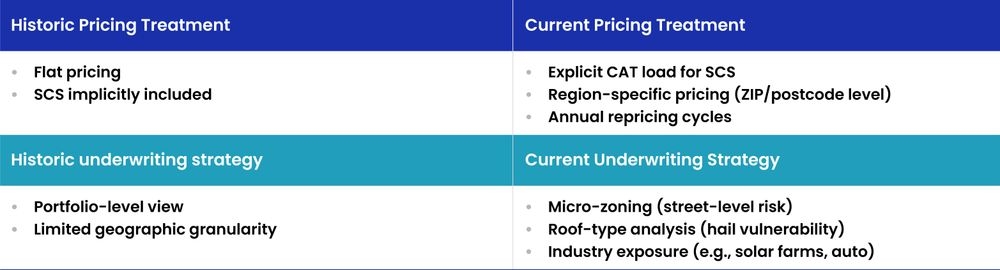
The reinsurance ecosystem had also witnessed the change. While in the past SCS rarely triggered any cover, now we often see Aggregate reinsurance covers, lower attachment points and the advent of parametric solutions around attributes like hail size, wind speed triggers etc.
So, the narrative has changed from “protection against rare events” to “protection against frequent accumulation losses”.
In summary, SCS has metamorphosized from background noise in underwriting to core driver of profitability, pricing, and capital strategy. It is imperative that we treat SCS as Annual expected loss (not tail risk) and embed into all three critical aspects of insurance viz.:
Severe Convective Storms have moved from being secondary perils to recurring drivers of insurance profitability, capital planning, and reinsurance strategy. Insurers now need to treat SCS as annual expected loss, not only as tail risk.
As frequency, exposure, and asset values continue to rise, insurers that build more granular and data-led views of SCS risk will be better positioned to manage volatility and protect underwriting performance. This is where advanced catastrophe risk modeling services can help insurers strengthen exposure analysis, scenario assessment, and portfolio-level risk monitoring.
Decimal Point Analytics supports insurers, reinsurers, and risk teams with data, analytics, and modelling-led solutions across underwriting, catastrophe risk, pricing, and portfolio monitoring.
Connect with us to explore how sharper risk analytics can help your team manage evolving CAT exposures with greater confidence.