Loading content...

Articles
The "Vibe Coding" Revolution: Moving from Syntax Laborers to Architects of Intent
The "Vibe Coding" Revolution: Moving from Syntax Laborers to Architects of Intent
All rights reserved ©2026 Decimal Point Analytics Pvt. Ltd.
For decades, the value of a software engineer was tied to their fluency in the arcane languages of machines. Mastery of syntax, memory management, and complex APIs was the barrier to entry. Today, that barrier is collapsing. The rise of Large Language Models (LLMs) and "agentic" workflows is ushering in a new era of "vibe coding", a term popularized by industry leaders to describe a shift where natural language and high-level intent become the primary tools of creation. This is not merely a productivity boost; it is a fundamental inversion of the engineering value chain. For leaders at companies like Bloomberg, Tesla, and NVIDIA, the challenge is no longer just about hiring coders; it’s about cultivating architects of intent who can orchestrate powerful AI agents to solve business problems at unprecedented speed. This report provides a framework for navigating this shift, reimagining core engineering principles, and offering a playbook for leading in the age of AI-assisted development.
Traditionally, software development ("Software 1.0") was a manual process of translating human desires into precise machine instructions. It was brittle, time-consuming, and required deep technical expertise. The cognitive load was heavily skewed toward the "how", how to write a loop, how to configure a server, how to fix a syntax error.
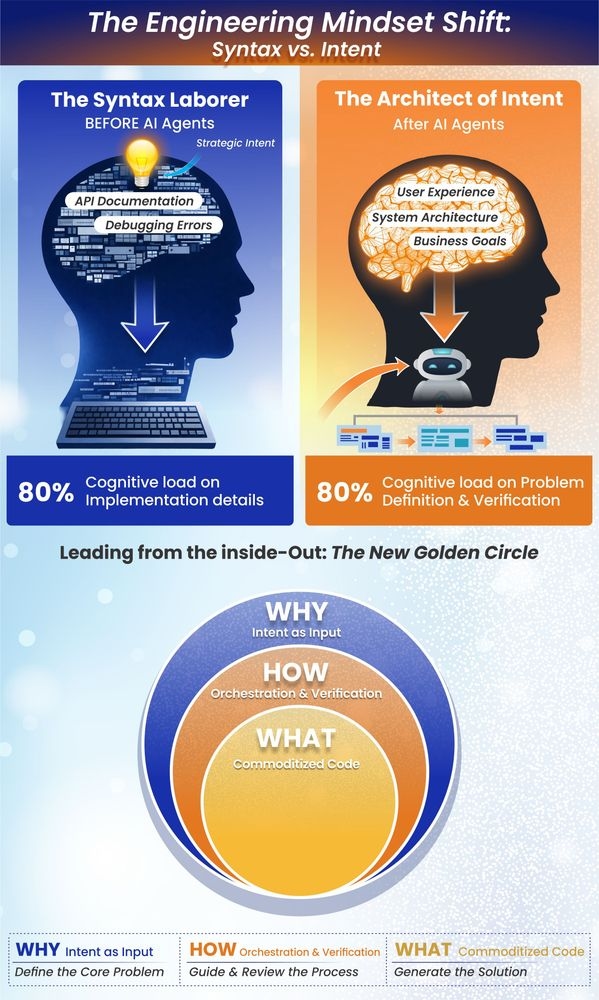
As Andrej Karpathy, former Director of AI at Tesla, famously articulated, we are moving through "Software 2.0" (neural networks where code is "learned" from data) into what can be described as an agentic, or "vibe-based," era. In this new paradigm, the primary programming language is English (or any natural language). The engineer's role shifts from writing the code to defining the "vibe", the desired outcome, constraints, and user experience, and then guiding a fleet of AI agents to execute that vision. The implication for business is profound: the bottleneck is no longer the speed of typing code, but the speed and clarity of thought.
For decades, Tim Peters' "Zen of Python" has served as a guiding philosophy for writing good code. Its aphorisms remain timeless, but their application must evolve for an age where machines write much of the code. Here is a reimagining of key principles for AI-assisted development.
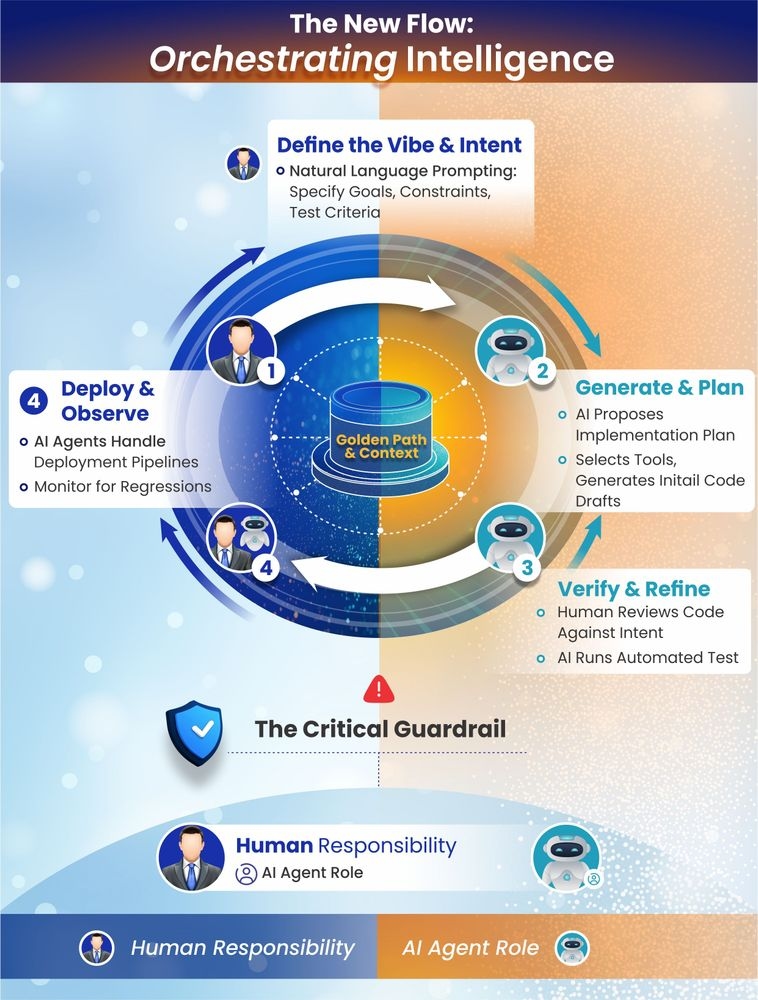
Leading a team through this transition requires a delicate balance of encouraging innovation while maintaining rigorous engineering standards.
The "vibe coding" revolution is not about the end of engineers; it is about the elevation of engineering. By abstracting away the tedious mechanics of syntax, AI empowers human beings to focus on what they have always done best: dreaming, reasoning, and creating. The companies that will thrive are not those with the most powerful AI, but those with the most clear-eyed human intent, driving their intelligent agents toward a meaningful "Why."